
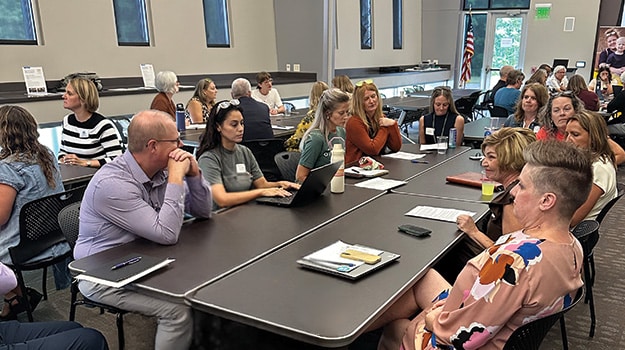

On August 27, United Way Quad Cities and OneTable QC brought together community leaders and human services organizations for a collaborative workshop. The workshop focused on identifying the challenges facing individuals and families across the Quad Cities, and exploring opportunities for public policy to help address them. Through cross-sector discussion, participants identified common barriers affecting health, education, financial security, and nonprofit organizations- and outlined policy priorities that could strengthen systems, improve access to services, and help create better outcomes for individuals and families throughout our community.
Cross-Sector Themes
- Workforce shortages drive poor outcomes and negatively impact access (e.g., behavioral health providers, therapists, specialized educators, childcare support, human services professionals)
- Families struggle to access existing services – they cannot find, afford, qualify for, or navigate systems effectively
- Economic stability provides the foundation for improving health and educational outcomes – poverty sits at the root of nearly all the issues facing clients of human services organizations
- Systems need simplification – fragmentation, administrative complexities, inconsistent definitions, and burdensome reporting requirements add to nonprofit and client burdens
Recommended Public Policy Priorities: Health
- Expand Behavioral Health Workforce Capacity – invest in tuition assistance, loan forgiveness, residency incentives, and workforce recruitment programs
- Improve access to affordable healthcare and Medicaid services – focus on Medicaid participation, reimbursement rates, provider acceptance, and reducing barriers to care
- Build a “Basic Needs First” strategy – advance policies that connect health outcomes to food security, housing stability, transportation, and economic security
Recommended Public Policy Priorities: Education
- Increase access to early childhood and family mental health support for pre-K and elementary-aged children
- Improve attendance through transportation and family support policies – including childcare, before-school care, and support for students experiencing homelessness
- Strengthen navigation and access systems for children with disabilities – reduce waiver waitlists, improve referral systems, and expand support services for children and young adults with disabilities and special needs
Recommended Public Policy Priorities: Financial Security
- Build career pathways through skills-based workforce development –expand trade education, certifications, apprenticeships, reentry pathways, and dual-credit career opportunities
- Advance housing affordability and housing rehabilitation – encourage reuse of abandoned properties, nonprofits housing models, and stronger accountability for maintaining housing stock
- Expand financial capabilities and asset building –financial literacy, culturally responsive financial education, homeownership preparation, banking access, and long-term wealth building
Recommended Public Policy Priorities: Nonprofit Administration
- Reform government contracting and reimbursement systems – simplify reporting, faster reimbursements, more consistent grant administration and adequate indirect costs
- Expand multi-year and capacity-building funding – longer funding cycles and true capacity-building investment instead of annual reapplications
- Strengthen nonprofit advocacy capacity – clarify nonprofit advocacy rules and create opportunities for nonprofits to participate in public policy discussions without fear